P-011 · AEAA-Style Public Audit

Public Audit Guide — How to Detect Adaptive Model Preservation

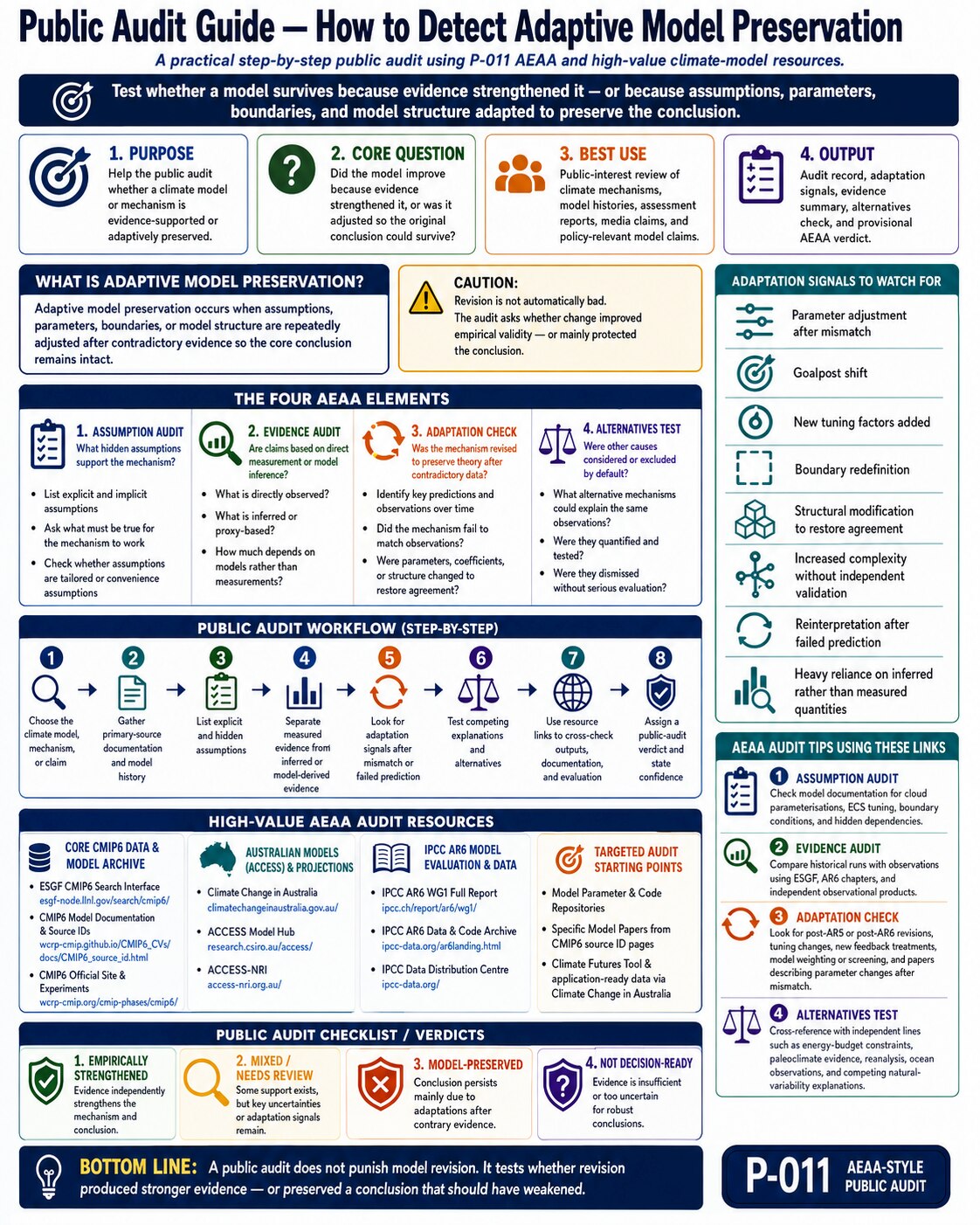
A practical step-by-step public audit using P-011 AEAA and high-value climate-model resources. Test whether a model survives because evidence strengthened it — or because assumptions, parameters, boundaries, and model structure adapted to preserve the conclusion.

Public Audit Guide P-011 infographic — how to detect adaptive model preservation

1. Purpose

Help the public audit whether a climate model or mechanism is evidence-supported or adaptively preserved.

2. Core Question

Did the model improve because evidence strengthened it, or was it adjusted so the original conclusion could survive?

3. Best Use

Public-interest review of climate mechanisms, model histories, assessment reports, media claims, and policy-relevant model claims.

4. Output

Audit record, adaptation signals, evidence summary, alternatives check, and provisional AEAA verdict.

What is adaptive model preservation?

Adaptive model preservation occurs when assumptions, parameters, boundaries, or model structure are repeatedly adjusted after contradictory evidence so the core conclusion remains intact.

Caution. Revision is not automatically bad. The audit asks whether a change improved empirical validity — or mainly protected the conclusion.
The Four AEAA Elements

Assumption, Evidence, Adaptation, Alternatives

1. Assumption Audit

What hidden assumptions support the mechanism?

  • List explicit and implicit assumptions
  • Ask what must be true for the mechanism to work
  • Check whether assumptions are tailored or convenience assumptions

2. Evidence Audit

Are claims based on direct measurement or model inference?

  • What is directly observed?
  • What is inferred or proxy-based?
  • How much depends on models rather than measurements?

3. Adaptation Check

Was the mechanism revised to preserve theory after contradictory data?

  • Identify key predictions and observations over time
  • Did the mechanism fail to match observations?
  • Were parameters, coefficients, or structure changed to restore agreement?

4. Alternatives Test

Were other causes considered or excluded by default?

  • What alternative mechanisms could explain the same observations?
  • Were they quantified and tested?
  • Were they dismissed without serious evaluation?
Public Audit Workflow

Eight steps, start to finish

1
Choose the climate model, mechanism, or claim
2
Gather primary-source documentation and model history
3
List explicit and hidden assumptions
4
Separate measured evidence from inferred or model-derived evidence
5
Look for adaptation signals after mismatch or failed prediction
6
Test competing explanations and alternatives
7
Use resource links to cross-check outputs, documentation, and evaluation
8
Assign a public-audit verdict and state confidence
Adaptation signals to watch for
  • Parameter adjustment after mismatch
  • Goalpost shift
  • New tuning factors added
  • Boundary redefinition
  • Structural modification to restore agreement
  • Increased complexity without independent validation
  • Reinterpretation after failed prediction
  • Heavy reliance on inferred rather than measured quantities
AEAA audit tips using these links
  • 1. Assumption AuditCheck model documentation for cloud parameterisations, ECS tuning, boundary conditions, and hidden dependencies.
  • 2. Evidence AuditCompare historical runs with observations using ESGF, AR6 chapters, and independent observational products.
  • 3. Adaptation CheckLook for post-AR5 or post-AR6 revisions, tuning changes, new feedback treatments, model weighting or screening, and papers describing parameter changes after mismatch.
  • 4. Alternatives TestCross-reference with independent lines such as energy-budget constraints, paleoclimate evidence, reanalysis, ocean observations, and competing natural-variability explanations.
High-value AEAA audit resources

Core CMIP6 Data & Model Archive

  • ESGF CMIP6 Search Interface
  • CMIP6 Model Documentation & Source IDs
  • CMIP6 Official Site & Experiments

Australian Models (ACCESS) & Projections

  • Climate Change in Australia
  • ACCESS Model Hub
  • ACCESS-NRI

IPCC AR6 Model Evaluation & Data

  • IPCC AR6 WG1 Full Report
  • IPCC AR6 Data & Code Archive
  • IPCC Data Distribution Centre

Targeted Audit Starting Points

  • Model Parameter & Code Repositories
  • Specific Model Papers from CMIP6 source ID pages
  • Climate Futures Tool & application-ready data via Climate Change in Australia
Public audit checklist / verdicts

1. Empirically strengthened

Evidence independently strengthens the mechanism and conclusion.

?

2. Mixed / needs review

Some support exists, but key uncertainties or adaptation signals remain.

3. Model-preserved

Conclusion persists mainly due to adaptations after contrary evidence.

4. Not decision-ready

Evidence is insufficient or too uncertain for robust conclusions.

"A public audit does not punish model revision. It tests whether revision produced stronger evidence — or preserved a conclusion that should have weakened."
Bottom Line