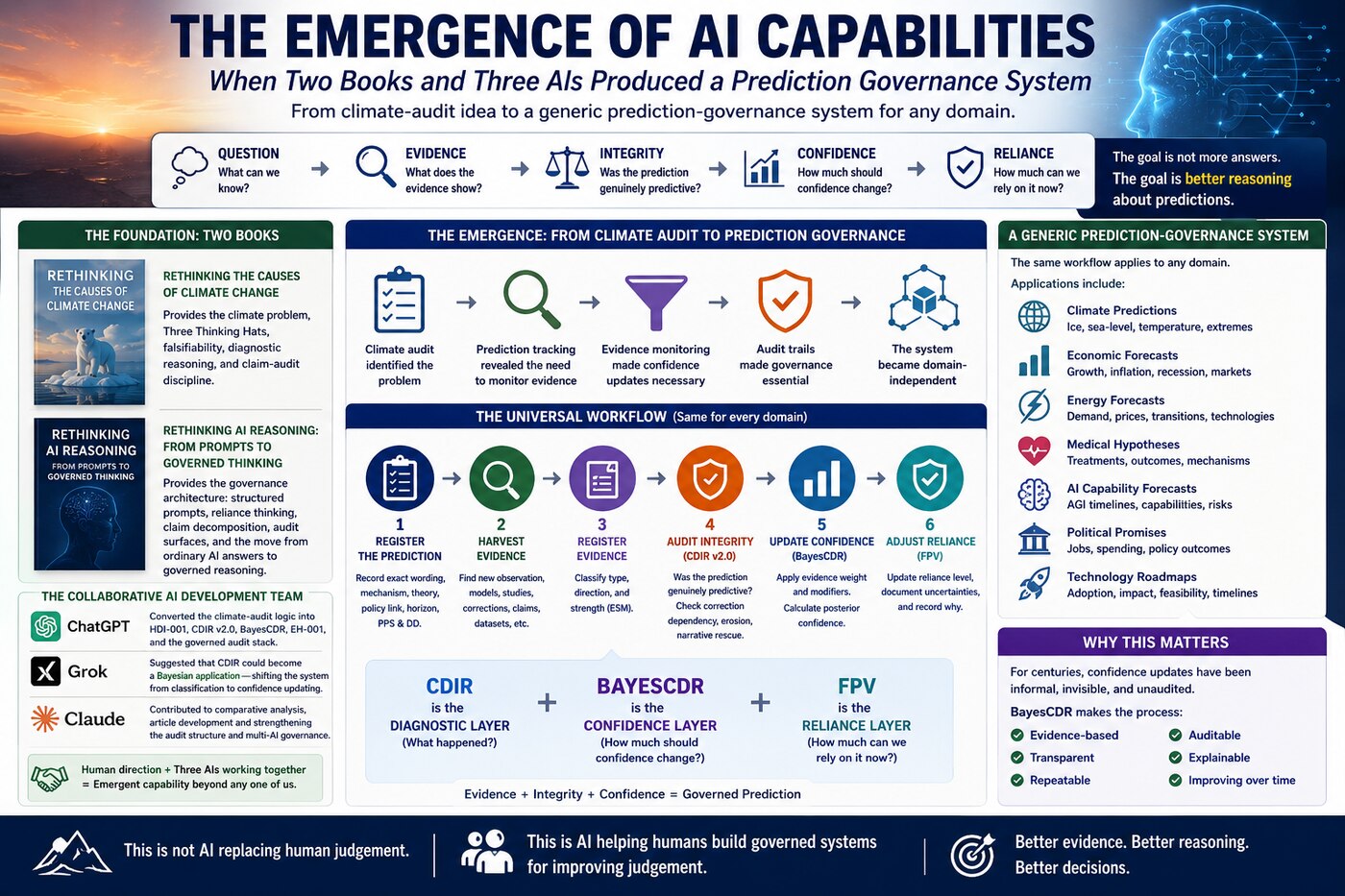
From climate-audit idea to a generic prediction-governance system for any domain. The goal is not more answers. The goal is better reasoning about predictions.
Provides the climate problem, the Three Thinking Hats, falsifiability, diagnostic reasoning, and claim-audit discipline.
Provides the governance architecture: structured prompts, reliance thinking, claim decomposition, audit surfaces, and the move from ordinary AI answers to governed reasoning.
Record exact wording, mechanism, theory, PPS & DD.
Find new observation, models, studies, corrections, claims, datasets.
Classify type, direction, and strength (ESM).
CDIR v2.0 — was the prediction genuinely predictive? Check correction dependency, erosion, narrative rescue.
BayesCDR — apply evidence weight and modifiers, calculate posterior confidence.
FPV — update reliance level, document uncertainties, record why.
The Diagnostic Layer
What happened?
The Confidence Layer
How much should confidence change?
The Reliance Layer
How much can we rely on it now?
Evidence + Integrity + Confidence = Governed Prediction
| Domain | Application |
|---|---|
| Climate Predictions | Ice, sea-level, temperature, extremes |
| Economic Forecasts | Growth, inflation, recession, markets |
| Energy Forecasts | Demand, prices, transitions, technologies |
| Medical Hypotheses | Treatments, outcomes, mechanisms |
| AI Capability Forecasts | AGI timelines, capabilities, risks |
| Political Promises | Jobs, spending, policy outcomes |
| Technology Roadmaps | Adoption, impact, feasibility, timelines |
For centuries, confidence updates have been informal, invisible, and unaudited. BayesCDR makes the process:
Human direction + three AIs working together = emergent capability beyond any one of us.