SyncLogic Claim-Classification & Vulnerability-Discovery Audit

Book Audited: Rethinking the Causes of Climate Change
Using Three Thinking Hats

A structural audit of the book itself — treating it as a reasoning system and classifying its postulates, methods, empirical claims, vulnerabilities, and candidate products.

This is a structural audit of the uploaded PDF, not a full external scientific fact-check against all climate literature. The book was treated as a reasoning system and its postulates, methods, empirical claims, vulnerabilities, and candidate products were classified accordingly.
1. Executive Summary

A postulate-driven audit framework, not a simple "no data" critique

The book is not best described as "not using data." That would be too easy to attack. The stronger classification is:

Type 3: Hybrid methodological-empirical critique with a Type 1 postulate-driven core.

The book's core contribution is methodological: it teaches readers to audit climate claims using falsifiability, physical constraints, diagnostic reasoning, Three Thinking Hats, AI MegaPrompts, AiQCompare tables, and red-flag logic filters. The book repeatedly frames itself as a method rather than a belief system, and invites readers to "test the ideas" and "run the prompts."

However, the book also makes many empirical and critique claims about CO₂, ice cores, ARGO, global average temperature, sea level, the Hockey Stick, Earth energy imbalance, models, Net Zero, and IPCC mechanisms. Those claims require external evidence, citations, and careful qualification. The "Six Pillars and Their Collapse" section is especially high-risk because it uses strong collapse language and claims each pillar reveals fundamental flaws.

The best immediate development target is not the whole climate argument. It is the audit framework: the 10-step diagnostic audit, Three Hats method, AiQCompare, MegaPrompt library, and claim-classification workflow. Chapter 48 is especially strong because it turns the book into a reproducible diagnostic pathway: causal clarity, physics check, logical consistency, falsifiability, transparency, predictive value, reproducibility, differential diagnosis, uncertainty quantification, and policy readiness.
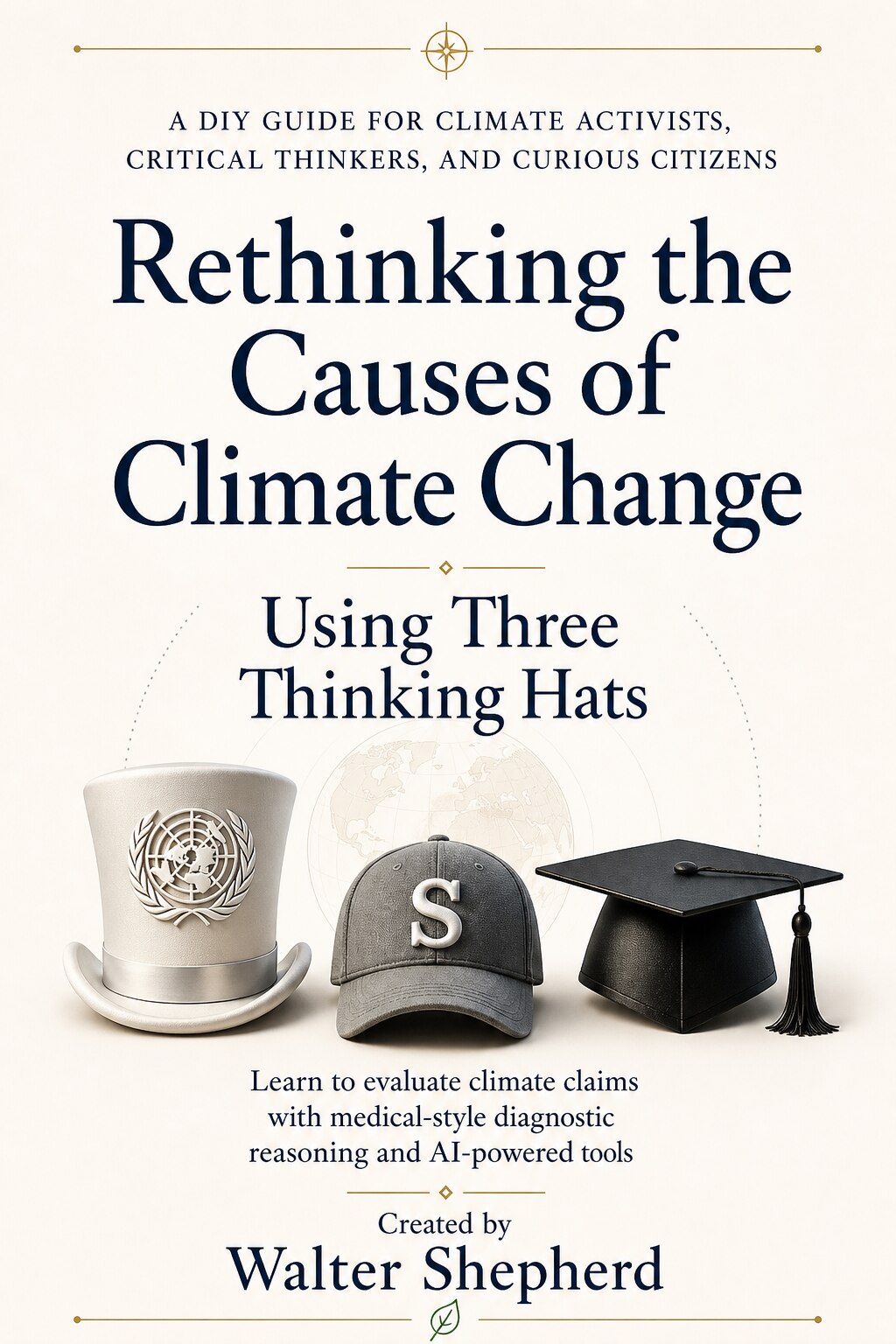
Book audited: Rethinking the Causes of Climate Change Using Three Thinking Hats
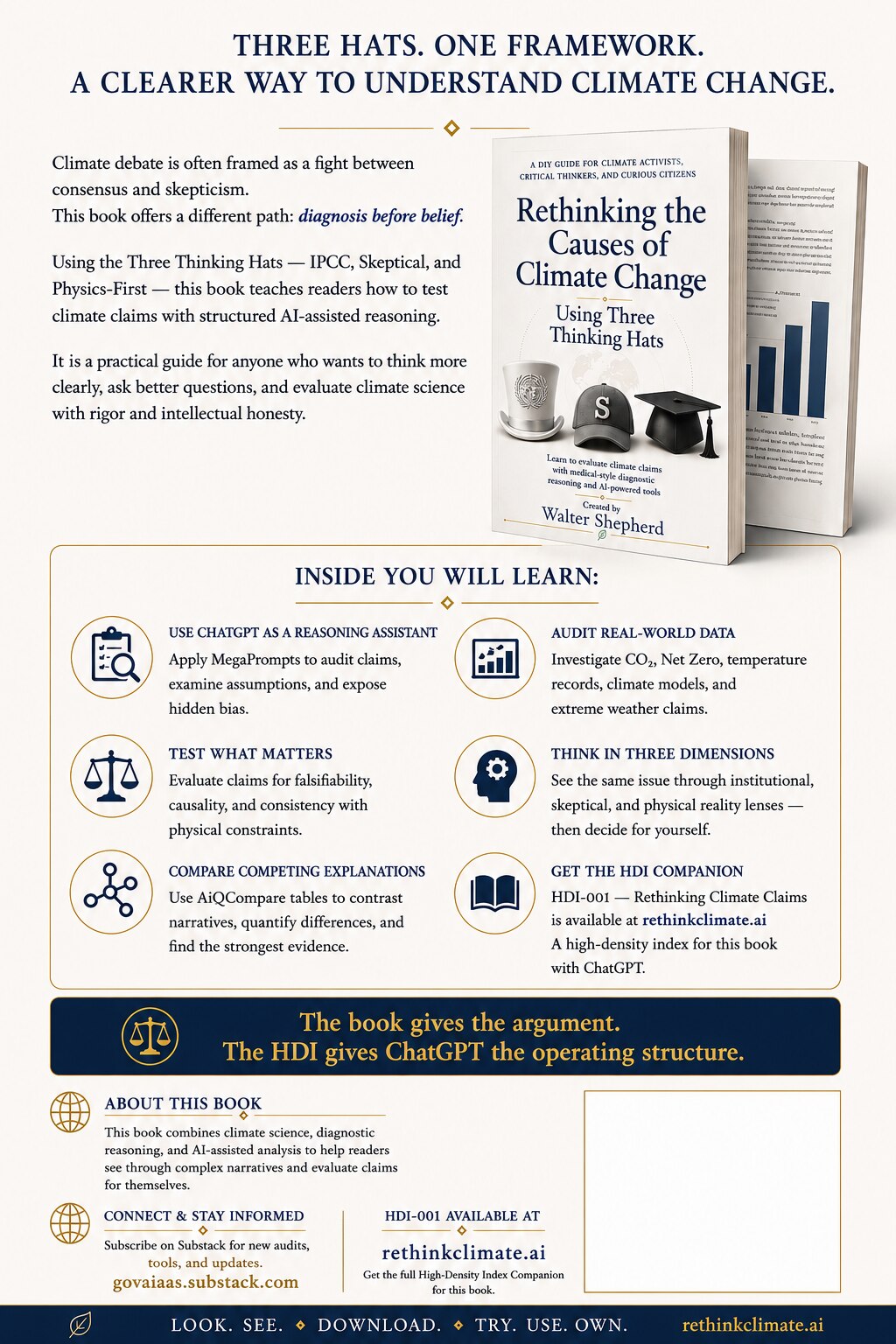
Book audited: Rethinking the Causes of Climate Change Using Three Thinking Hats

2. Claim Classification Table

15 major claims, classified and scored

Scored 1–5 on Evidence, Clarity, Novelty, Overclaim risk, and Falsifiability, with a priority rating for development.

IDMajor claimLocationTypeEvid.ClarityNoveltyOverclaimFalsifiablePriority
CL-001Climate claims should be audited, not merely trusted.Preface, Ch.1P2, C145314High
CL-002Consensus is not the same as scientific truth.Ch.1P1, P245223High
CL-003A valid climate claim should be falsifiable, testable, and physically constrained.Ch.1, Ch.48P1, P245315High
CL-004Three Thinking Hats improve climate reasoning by triangulating IPCC, Skeptical, and Physics-First perspectives.Ch.2P2, IP135423High
CL-005ChatGPT can become a structured climate audit assistant when governed by reasoning modes, lenses, and MegaPrompts.Ch.3–8, appendicesP2, IP135424High
CL-006Climate science lacks an independent third-party audit body equivalent to FDA/TGA-style review.PrefaceC1, A1, P224343High but needs support
CL-007Climate models are often tuned to match the past and then used to project the future without adequate separation of input and output.PrefaceC1, V124344High but risky
CL-008Earth should be analysed as a thermodynamic heat engine / adaptive climate intelligence system.Ch.11–12H1, P223444Medium–High
CL-009The six pillars of climate certainty collapse under diagnostic analysis.Ch.15–23C1, E1, V124354High but high-risk
CL-010IPCC mechanisms should be audited through entropy, assumptions, and adaptive evidence checks.Ch.24–34P2, C1, IP134434High
CL-011Climate models need a scientific gauntlet / challenge matrix.Ch.35–37P2, IP134424High
CL-012AiQCompare can compare how claims morph across scientific, media, YouTube, and policy contexts.Ch.39–41IP1, P235424High
CL-013Red Flag Reasoning can detect flawed logic before it spreads.Ch.42IP1, V134424High
CL-014Climate hypotheses should pass a 10-step diagnostic audit before influencing policy.Ch.48P2, IP145415Very High
CL-015Net Zero may be the wrong treatment if the climate diagnosis is wrong.Preface, Ch.34H1, C1, A124344Medium–High
3. Postulate & Methodological Rule Register

Ten core rules, audited and refined

IDPostulate / ruleClass.Audit findingRequired refinement
POST-001Audit is testing, not attacking.P2Strong framing; gives the book a defensible non-denialist posture. Ch.1 defines audit as checking logic, falsifiability, physics, alternatives, and empirical grounding.Keep. Use as opening principle.
POST-002Consensus ≠ truth.P1/P2Strong philosophical principle, but should not imply consensus is worthless.Reword: "Consensus may be informative but is not a substitute for falsifiability and mechanism."
POST-003Falsifiability is required for scientific status.P1Strong and well aligned with the book's diagnostic framework.Keep, but distinguish Popperian falsifiability from practical model evaluation.
POST-004Claims must pass physical constraint checks.P1/P2Strong. Repeatedly uses energy, entropy, and thermodynamics as constraint tests.Keep, but avoid implying simple thermodynamic checks alone settle complex attribution.
POST-005Diagnosis before prescription.P2Very strong organising principle; connects climate policy to medical/engineering analogies.Use as the bridge between book, paper, and product.
POST-006Multiple hats reduce blind spots.P2/IP1Strong educational method; one of the clearest productisable assets.Define scoring rules so it is more than a perspective exercise.
POST-007AI needs governance, not just prompting.P2/IP1Strong candidate. ChatGPT mirrors reasoning structures and needs modes/lenses to become useful for audits.Upgrade from "MegaPrompt" language to "governed reasoning workflow."
POST-008Model output should not be treated as independent observation.P2/C1/V1Important but needs external support and precise examples.Develop as a formal vulnerability pattern.
POST-009Differential diagnosis should precede policy reliance.P2Strong; compatible with IVD-style reasoning. Ch.48 requires competing mechanism comparison as part of the diagnostic audit.Make this a named principle.
POST-010Sequential Attribution Principle.P1 candidateImportant but not yet clearly embedded as a named principle in the book PDF — appears more clearly in session notes.Add to revised edition, appendix, or paper as a formal postulate.
4. Evidence Claim Register

Eight evidence claims and their audit status

IDEvidence claimBook treatmentAudit status
EV-001Medical/IVD-style diagnostics require causation, repeatability, performance metrics, and auditability.Used as a cross-domain analogy and credibility bridge.Strong analogy, but needs careful boundary: climate models are not medical devices.
EV-002Climate models lack FDA/TGA-style independent audit.Strong preface claim.Needs external citations and comparison to existing model intercomparison/review practices.
EV-003Models are tuned to match the past and then used to project the future.Strong critique in preface.Needs precise evidence: model tuning practices, hindcast/forecast validation literature, CMIP documentation.
EV-004Six climate evidence pillars contain flaws.Treated as central diagnostic case study.High-risk. Needs chapter-by-chapter evidence table and alternative mainstream interpretation.
EV-005Earth climate should be modelled as a thermodynamic heat engine, not only through radiative forcing.Ch.11–12.Promising but must avoid straw-manning climate models as "radiative transfer only."
EV-006AI tools can audit climate claims using MegaPrompts, Logic Lenses, and AiQCompare.Core practical toolset.Strong as a method; needs validation examples and reproducibility testing.
EV-007Red-flag reasoning can expose faulty claims in peer-reviewed and public materials.Ch.42 and related sections.Strong as an audit heuristic; needs scoring rubric and inter-rater reliability testing.
EV-008The 10-step diagnostic pathway can determine policy readiness.Ch.48.Very strong candidate for formal paper/product; needs operational scoring thresholds.
5. Vulnerability Pattern Register

Ten recurring failure mechanisms

IDVulnerability patternFailure mechanismWhere detectedDevelopment potential
VUL-001Consensus substitutionAgreement is treated as stronger than mechanism, falsifiability, or uncertainty.Ch.1High
VUL-002Model-output authority transferModel outputs are treated as independent evidence rather than conditional outputs.Preface, Ch.24–37Very High
VUL-003Circular attributionA conclusion is embedded in model assumptions and later cited as model-confirmed.Ch.1, Ch.18, Ch.32Very High
VUL-004Missing failure conditionA claim is insulated from possible disconfirmation.Ch.1, Ch.48High
VUL-005Physics bypassStatistical or narrative certainty outruns physical constraint testing.Ch.10, Ch.19, Ch.48High
VUL-006Uncertainty compressionCaveats are reduced as claims move toward policy or media.Ch.14, Ch.39–42High
VUL-007Scope inflationA bounded finding becomes a broad policy claim.Throughout policy sectionsHigh
VUL-008Rhetorical certaintyEmotionally compelling framing substitutes for testable logic.Ch.1, Ch.4, Ch.42Medium–High
VUL-009Analogy overreachMedical, bridge, or engineering analogies become stronger than the evidence.Preface, Ch.1, Ch.48Medium
VUL-010Collapse-language escalation"Needs audit" becomes "has collapsed" before the evidential burden is fully discharged.Ch.15–23Very High risk
6. Candidate Development Records

Eight candidates for a paper, product, or protocol

Each candidate is scored for problem, mechanism, workflow, dependencies, falsification test, and next step.

SL-CAND-001

Diagnostic Climate Claim Audit

Candidate typeAudit instrument / product-service candidate
Problem addressedClimate claims are often accepted or rejected based on authority, ideology, or headline framing rather than structured testing.
Existing approachesPeer review, literature review, model intercomparison, expert consensus, media fact-checking.
Proposed solutionA repeatable audit workflow using falsifiability, physical constraints, causal clarity, uncertainty, and competing explanations.
MechanismExtract claim → classify claim → test falsifiability → check physical constraints → compare alternatives → assess reliance.
Inputs / OutputsInputs: climate claim, article, paper, report, transcript, model claim, IPCC statement. Outputs: claim audit table, red flags, reliance recommendation, falsification questions.
WorkflowClaim extraction → neutral rewrite → Three Hats → Logic Lens testing → scoring → verdict.
ComponentsClaim template, Three Hats, reasoning modes, logic lenses, red-flag checklist.
DependenciesClear claim wording; evidence access; consistent scoring rubric.
Falsification testIf different auditors produce inconsistent results, scoring rules are under-defined.
Intended usersReaders, journalists, policy analysts, educators, independent researchers.
Overclaim riskMedium — tool should not claim to settle climate science by itself.
Recommended next stepConvert into a formal scoring template and test across 10 claims.
SL-CAND-002

Three Thinking Hats Climate Reasoning Framework

Candidate typeMethodological rule / product candidate
Problem addressedClimate debate collapses into two-sided argument instead of structured multi-perspective reasoning.
Proposed solutionCompare each claim through IPCC, Skeptical, and Physics-First lenses.
MechanismEach hat states assumptions, evidence preference, blind spots, and falsification questions.
WorkflowClaim → IPCC Hat → Skeptical Hat → Physics-First Hat → triangulated verdict.
ComponentsHat definitions, assumption list, blind-spot checklist, final synthesis.
DependenciesFair representation of each hat; no straw-manning.
Falsification testIf one hat is consistently caricatured, the framework becomes advocacy, not audit.
Intended usersStudents, public readers, teachers, analysts.
Overclaim riskMedium — must avoid implying all three hats are equally evidential in every case.
Recommended next stepBuild a one-page worksheet and worked example.
SL-CAND-003

Sequential Attribution Principle

Candidate typePostulate candidate / paper candidate
Problem addressedComplex causal systems may assign residual effects to a favoured cause before identifiable upstream mechanisms are adequately bounded.
Proposed solutionBefore high-confidence attribution to a residual cause, recognised material upstream influences must be identified, bounded, corrected where feasible, and carried forward with explicit uncertainty.
MechanismForces causal sequence before reliance: identify → bound → subtract/correct → propagate uncertainty → assign residual.
WorkflowMap causal chain → locate residual assignment → identify upstream mechanisms → check treatment → score attribution reliance.
ComponentsMechanism register, residual definition, uncertainty transfer map, reliance class.
DependenciesNeeds formal definition; must be aligned with measurement science without overstating as settled law.
Falsification testIf target methods already explicitly bound and propagate material upstream mechanisms, the vulnerability is reduced.
Intended usersScientific auditors, paper reviewers, policy analysts, AI governance teams.
Overclaim riskHigh if called a "law" rather than a proposed postulate.
Recommended next stepConvert into a dedicated paper section or technical appendix.

Note: this principle is clearly present in the Gemini/session notes, but was not found as a named core postulate in the uploaded book PDF. It should be added explicitly if it is now central to the project.

SL-CAND-004

10-Step Scientific Diagnostic Audit

Candidate typeAudit instrument / paper candidate / product candidate
Problem addressedClimate claims can move from hypothesis to policy without passing a standardised diagnostic threshold.
Proposed solutionA structured pathway: causal clarity, physics check, logical consistency, falsifiability, transparency, predictive value, reproducibility, differential diagnosis, uncertainty, policy readiness.
MechanismConverts broad scientific credibility into staged pass/fail or downgrade tests.
WorkflowApply 10 tests in order; downgrade or reject at each failure point.
Components10 tests, scoring rules, threshold rules, reliance categories.
DependenciesNeeds operational definitions for each score.
Falsification testIf the test gives arbitrary or inconsistent outputs, it needs tighter rules.
Intended usersReviewers, analysts, educators, policy advisers.
Overclaim riskLow–Medium — strongest if presented as audit support, not final truth machine.
Recommended next stepTurn Chapter 48 into a standalone white paper.

Chapter 48 is one of the most defensible parts of the book because it gives a structured diagnostic framework rather than only making a climate claim.

SL-CAND-005

AiQCompare — Climate Claim Comparator

Candidate typePrompt/tool architecture / product candidate
Problem addressedThe same claim changes meaning across scientific papers, IPCC summaries, media articles, podcasts, and political speech.
Proposed solutionA structured comparison table showing how claims morph across contexts.
MechanismExtract claim versions → classify evidence basis → compare framing → identify drift, exaggeration, or missing caveats.
WorkflowSource ingestion → claim extraction → context classification → comparison → audit verdict.
ComponentsClaim extractor, source-type labels, framing categories, red-flag logic.
Falsification testIf it cannot distinguish legitimate simplification from distortion, it will over-flag.
Intended usersJournalists, educators, readers, public auditors.
Overclaim riskMedium
Recommended next stepConvert into website/app worksheet or spreadsheet template.
SL-CAND-006

MegaPrompt Climate Audit Library

Candidate typePrompt/tool architecture / IP candidate
Problem addressedGeneric AI prompts produce shallow, consensus-shaped, or inconsistent answers.
Proposed solutionReusable structured prompts that force reasoning mode, lens, evidence type, and output format.
MechanismPrompt acts as a reasoning contract: role, task, claim, lenses, constraints, output.
WorkflowSelect prompt → insert claim/source → run → challenge output → record audit.
ComponentsPrompt A–E, AAA, CEA, KSA, red-flag prompts, audit templates.
Falsification testIf different models produce divergent unsupported conclusions, the library needs governance layers.
Intended usersPublic readers, researchers, writers, policy analysts.
Overclaim riskMedium — AI output is not evidence unless source-grounded.
Recommended next stepConvert into GitHub/Zenodo release with version numbers.
SL-CAND-007

Climate Model Challenge Matrix

Candidate typeAudit instrument / research program
Problem addressedModel credibility can be asserted without a visible challenge protocol.
Proposed solutionA reader-facing gauntlet for testing models against physical, predictive, and uncertainty constraints.
MechanismModels are challenged against predefined tests: mechanism, sensitivity, out-of-sample forecast, uncertainty, physical coherence.
WorkflowIdentify claim → map assumptions → apply challenge tests → classify reliance.
ComponentsModel challenge matrix, ECS example, 17 challenges.
Falsification testIf existing modelling literature already addresses the challenge, the audit must acknowledge it.
Intended usersPolicy analysts, science communicators, reviewers.
Overclaim riskMedium–High if it implies models are untested.
Recommended next stepConvert into a technical appendix with references.
SL-CAND-008

Red Flag Reasoning Filter

Candidate typeVulnerability pattern / product-service candidate
Problem addressedWeak claims spread quickly because readers lack a fast logic filter.
Proposed solutionA 60-second logic audit for circularity, unfalsifiability, scope inflation, model dependency, and rhetorical framing.
MechanismThe reader checks the claim against recurring failure modes before accepting or sharing it.
WorkflowExtract claim → apply checklist → classify red flags → escalate if needed.
ComponentsRed flag taxonomy, examples, scoring rules.
Falsification testIf it flags too broadly, it becomes rhetoric rather than audit.
Intended usersPublic readers, students, journalists, educators.
Overclaim riskMedium — the phrase "Climate Lysenkoism" is rhetorically strong and may reduce academic acceptance.
Recommended next stepKeep sharp rhetoric for Substack; use neutral language in papers.
Three Hats. One Framework. A clearer way to understand climate change — book back cover
From the back cover

"The book gives the argument. The HDI gives ChatGPT the operating structure."

The candidates below convert that argument and structure into standalone instruments — some ready for a worksheet or app, others needing formal definition before they can carry academic or policy weight.

7. Paper / Product / IP Pathway Table

Where each candidate should go next

CandidateBest pathwayReason
Diagnostic Climate Claim AuditWebsite tool + PDF worksheet + Substack seriesEasy for readers to use immediately.
Three Thinking HatsBook chapter + teaching handout + app workflowStrong public-facing structure.
Sequential Attribution PrincipleAcademic paper / OSF / SSRN / arXiv candidateNeeds formal definition and citations.
10-Step Diagnostic AuditWhite paper + technical appendix + productStrongest rigorous framework.
AiQCompareSpreadsheet/app + prompt toolClear practical use case.
MegaPrompt LibraryGitHub/Zenodo releaseVersionable, DOI-backed, reusable.
Climate Model Challenge MatrixTechnical appendix + peer-response toolNeeds detailed references.
Red Flag Reasoning FilterPublic explainer + classroom handoutUseful but should be separated from high-stakes scientific claims.
8. Overclaim & Risk Register

Ten phrases to soften — and how

IDOverclaim / vulnerabilityWhy it is riskyRecommended repair
RISK-001"The six pillars collapse."Stronger than "needs audit" and demands heavy evidence.Reframe as "six pillars expose audit vulnerabilities."
RISK-002"There is no Climate FDA."Useful analogy, but critics may say climate science has assessment and review structures.Say "there is no direct regulatory equivalent to pre-market approval for planetary model claims."
RISK-003"Models replace measurements."Too broad; many models are measurement-constrained.Say "some policy communication can blur model output and observation."
RISK-004"IPCC models fall short."Broad institutional critique needs chapter-specific evidence.Convert to claim-by-claim audit table.
RISK-005"The Hockey Stick erased the past to save the narrative."Sounds polemical and intentional.Use neutral wording: "The reconstruction is vulnerable to proxy-selection and smoothing critiques."
RISK-006"Anyone can audit climate science."Good democratizing message, but can sound anti-expertise.Say "anyone can perform a first-pass logic audit; expert review remains necessary for technical claims."
RISK-007"AI makes scientific accountability public."Strong and attractive but could overstate AI reliability.Add: "when source-grounded, structured, and independently checked."
RISK-008"Physics-First is immune to narrative drift."No method is immune to bias.Say "Physics-first reduces one class of narrative drift."
RISK-009"Heat engine model vs IPCC model."May create a false dichotomy if IPCC models already include thermodynamics, fluid dynamics, and ocean-atmosphere coupling.Reframe as "heat-engine audit lens," not replacement model unless mathematically specified.
RISK-010"Sequential Attribution Principle as law."Critics will attack the word "law."Call it a "proposed measurement-governance postulate."
9. Falsification Challenge List

Challenges the framework should welcome

A framework that cannot be challenged is not a diagnostic tool. These are the tests that would weaken the book's framework — presented deliberately, in keeping with its own falsifiability principle.

See the frameworks this audit points to